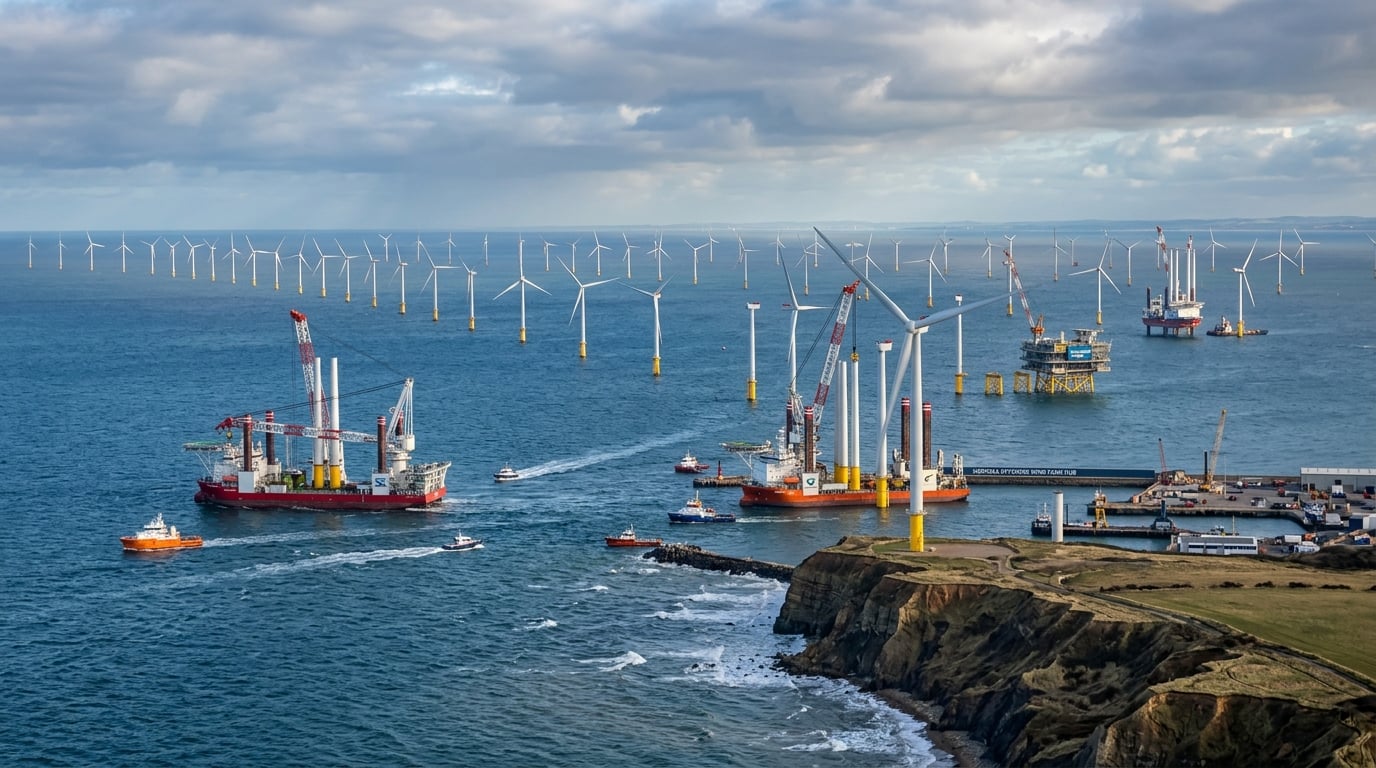
If you’d told someone a decade ago that wind power would one day supply more than a quarter of Britain’s electricity, they might have raised an eyebrow. But here we are. In the first quarter of 2025, wind energy provided 28.5% of the UK’s total electricity generation — and that figure is only heading in one direction.
The UK has become the undisputed European leader in offshore wind, with a pipeline of projects and a level of government commitment that is drawing serious attention from global investors. Whether you’re a seasoned fund manager or someone exploring alternatives to traditional asset classes, the UK wind sector is increasingly hard to ignore.
The Numbers That Tell the Story
Step back and look at the scale of what’s already been built, and the ambition behind what comes next, and it becomes clear this isn’t just an environmental story — it’s an economic one.
The UK currently has over 9,200 onshore turbines spread across 2,656 wind farms, alongside more than 2,800 offshore turbines on 44 farms. Combined, that delivers an installed capacity of over 31 gigawatts (GW) — enough to power more than 25 million homes every year. Those are substantial numbers. But they pale against what the government has set as its 2030 targets.
Labour’s energy plan calls for doubling onshore wind capacity to 30 GW while quadrupling offshore capacity from around 15 GW to 60 GW. Delivering on that timeline would require an extraordinary mobilisation of capital — and the early signs suggest that capital is very much willing to show up.
In the UK wind power generation industry, revenue is projected to grow to £5.6 billion in 2025-26, representing an 8.1% rise year-on-year. Profit margins in the sector sit at around 22.5%, reflecting the low marginal cost of wind generation once turbines are in place. For investors used to the volatility of equity markets, those are quietly attractive fundamentals.
The Record-Breaking AR7 Auction
The clearest signal of where investor confidence currently sits came in January 2026, when the UK government announced the results of its seventh Contracts for Difference (CfD) allocation round — known as AR7.
The auction secured 8.4 GW of offshore wind capacity across 12 projects, the largest haul in the scheme’s history. It was described by Energy UK as “the most competitive and most successful auction in the UK’s history.” More importantly for investors, those 8.4 GW are expected to unlock £22 billion of private sector investment — committed, contracted, and on its way into the UK economy.
The scheme has been running since 2014 and has, as of late 2025, already enabled roughly £85 billion of investment into the UK economy, adding around 0.25% to GDP each year according to Energy UK analysis. The CfD model works by giving developers a guaranteed “strike price” for the electricity they generate, providing certainty over long-term revenues that allows project finance to flow. The AR7 strike price for offshore wind was set at £91.20 per MWh — higher than recent rounds, but still significantly below the estimated £147/MWh cost of new-build gas.
KPMG’s Head of Energy and Natural Resources, Simon Virley, called the AR7 results “a strong signal that the UK remains a leading destination for clean energy investment,” noting that the government’s decision to extend CfD contract terms for offshore wind to 20 years had been crucial in maintaining developer confidence.
A Global Magnet for Capital
One of the most striking features of the current UK wind investment story is how international it has become. In May 2026, Abu Dhabi sovereign wealth fund Mubadala committed $325 million to Ørsted’s Hornsea 3 offshore wind farm — a 2.9 GW project off the Norfolk coast that will eventually power more than 3.3 million UK homes.
That’s not an isolated example. In AR7 alone, German energy giant RWE secured Contracts for Difference for 6.9 GW of capacity across five projects, entering a partnership with global investment firm KKR to develop the Norfolk Vanguard East and West projects. When KKR is financing offshore wind in the North Sea, you know the asset class has genuinely matured.
Great British Energy — the government’s new publicly owned clean energy company — is also actively mobilising capital. In June 2025, the government and Great British Energy joined forces with industry and The Crown Estate to invest £1 billion in offshore wind supply chains. The focus is on industrial heartlands including Teesside, Scotland, South Wales and East Anglia — communities with the skills base and infrastructure to support a long-term manufacturing boom.
What Investors Need to Know
For those considering exposure to the UK wind sector, there are several distinct routes. Listed investment trusts like Greencoat UK Wind — which as of December 2025 owned 49 individual wind farms with a split of roughly 57% onshore to 43% offshore — offer a relatively accessible entry point. The trust increased its 2026 dividend target to 10.70p per share, up from 10.35p in 2025, positioning itself as an inflation-linked income play.
That said, investors should be clear-eyed about the risks. Regulatory changes can affect returns — from April 2026, the inflation measure used in one support scheme switched from RPI to CPI, which typically runs lower and will reduce inflation-linked revenue for some assets. Single-sector exposure to wind also carries concentration risk, and construction timelines in offshore wind can stretch beyond initial projections.
There is also the question of grid capacity. With nine major projects — representing some 11,500 MW in combined capacity — under construction at the end of 2025, and a further pipeline behind them, connecting all of that generation to homes and businesses remains a genuine logistical challenge.
The Bigger Picture
But zoom out, and the direction of travel is unmistakable. The cost of wind energy has fallen more than 70% since 2010. The UK’s geography — some of the windiest waters in the world sit on its doorstep — gives it a structural advantage that no amount of policy tinkering can replicate. And the shift away from fossil fuel dependence, made urgent again when global instability in the Middle East sent energy prices spiking by more than 15% in a single week in 2025, has put energy security firmly back on the political agenda.
The UK’s wind farm sector isn’t just a story about clean energy. It’s a story about where serious money is going, for serious reasons, over a serious timeframe. That’s worth paying close attention to.
This article is for informational purposes only and does not constitute financial advice. Investments in energy infrastructure carry risk. Please consult an independent financial adviser before making any investment decision.