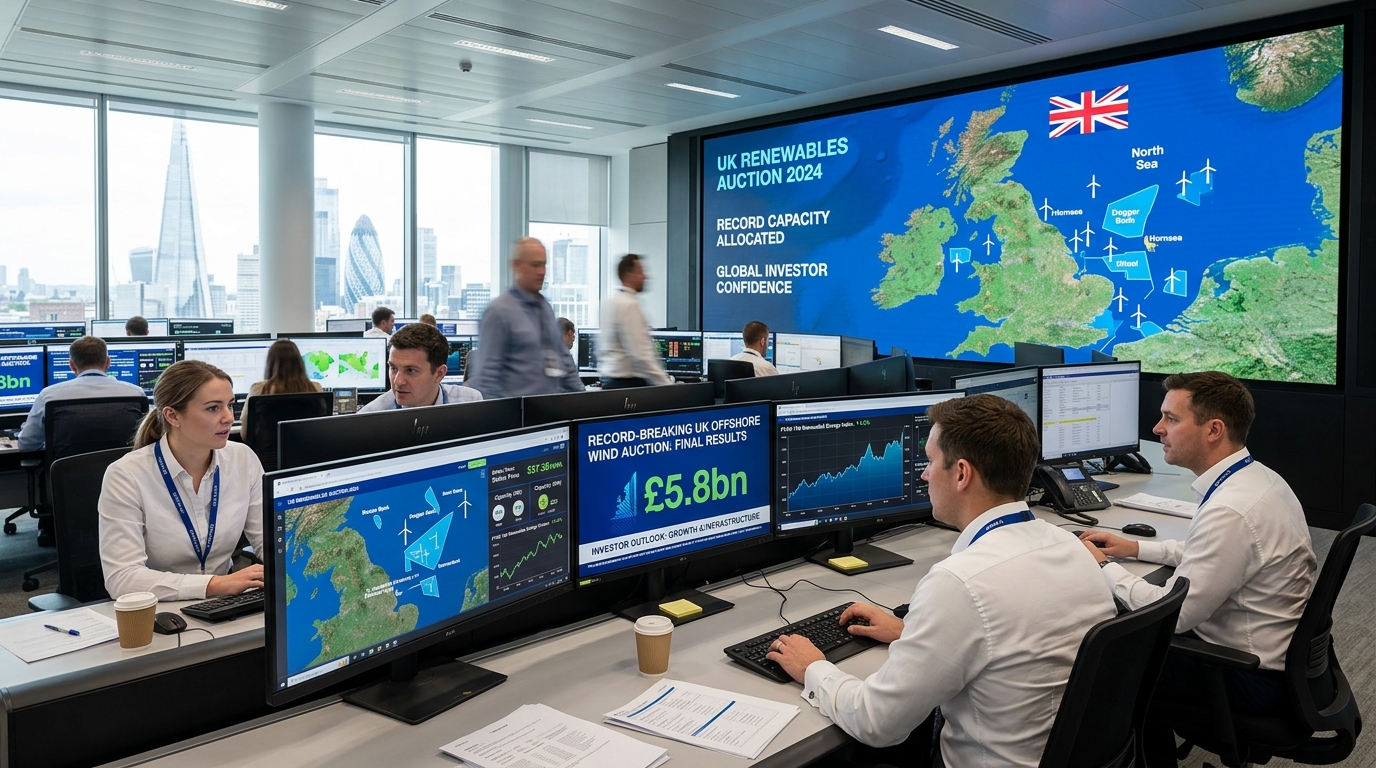
In the world of renewable energy investment, January 2026 will be remembered as a landmark month. The UK government published the results of its seventh Contracts for Difference auction — AR7 — and the numbers were genuinely extraordinary. Eight-point-four gigawatts of offshore wind capacity, secured across 12 projects, with an estimated £22 billion of private sector investment set to follow. It was the most successful offshore wind auction in UK history, and it sent a clear message to the global investment community: the UK is open for business, and the pipeline is very real.
But to understand why AR7 matters — and what it means for anyone thinking about wind energy as an investment theme — it helps to understand the system behind it.
How the CfD Scheme Works
The Contracts for Difference scheme has been the backbone of the UK’s renewable energy expansion since 2014. At its core, the mechanism is straightforward: developers compete in competitive auctions to secure a fixed “strike price” for the electricity their projects will generate. If wholesale electricity prices fall below the strike price, the developer receives a top-up payment. If prices rise above it, they pay the difference back. The result is a guaranteed, predictable revenue stream — exactly the kind of certainty that makes it possible to finance a £3 billion offshore wind project.
As of November 2025, the CfD scheme had 10 GW of projects in full operation — enough to power approximately 15 million homes — and had facilitated around £85 billion of investment into the UK economy over its lifetime, according to Energy UK. That works out to roughly 0.25% added to GDP each year. Not bad for a scheme most people outside the energy sector have barely heard of.
The AR7 auction, which formally opened in August 2025 and received sealed bids in November, delivered results that exceeded most forecasts. Twelve projects secured 20-year contracts at a strike price of £91.20 per MWh (in 2024 prices, inflation-indexed). While that’s higher than previous rounds, context matters: the average UK wholesale electricity price for 2025 ran above £80/MWh, and building new gas capacity is estimated to cost around £147/MWh. Offshore wind, even at these prices, remains competitive.
The Projects at the Centre of It All
The AR7 results revealed just how concentrated the winning bids were — and how seriously the biggest names in global energy have committed to the UK.
RWE, one of the world’s largest renewable energy companies, was involved in nine of the 12 successful bids, securing CfDs for a combined 6.9 GW of capacity. Its projects include Norfolk Vanguard East and West — which together account for roughly half of all the gigawatts awarded in the round — alongside two phases of Dogger Bank South and the Awel y Môr farm in the Welsh Irish Sea. To finance the Norfolk Vanguard projects, RWE agreed a long-term partnership with KKR, the global investment giant. That kind of institutional backing doesn’t happen in sectors without long-term credibility.
Meanwhile, Dogger Bank Wind Farm — the project that will eventually become the world’s largest offshore wind farm at 3.6 GW — was already in its initial commissioning phase by late 2025. An independent economic analysis published in November 2025 found that Dogger Bank would contribute £6.1 billion to the UK economy over its operational lifetime, supporting an average of 1,400 full-time equivalent jobs throughout its 35-year lifespan. In 2025 alone, approximately 3,600 FTE jobs were expected to be supported by the project, with 1,500 of those concentrated in the North-East of England and Yorkshire.
Floating Offshore Wind: The Next Frontier
One of the more significant aspects of AR7 was its inclusion of floating offshore wind — a technology that could fundamentally expand the geography of wind energy development. Fixed-bottom turbines are limited to relatively shallow waters. Floating platforms, by contrast, can be deployed in deeper seas, opening up vast new areas of ocean resource.
Two floating wind projects secured contracts in AR7: Erebus, in the Celtic Sea, and Pentland, off the coast of Scotland. Both received backing from Great British Energy and the National Wealth Fund — a deliberate signal from the government that it views floating wind as strategically important, not just an interesting experiment.
The administrative strike price cap for floating wind was set at £271/MWh for AR7, compared to £113/MWh for fixed-bottom projects, reflecting the higher development costs of an emerging technology. But the principle of de-risking early-stage projects through guaranteed revenue is precisely how the UK scaled fixed-bottom offshore wind from a curiosity to a cornerstone of its energy system — and there’s every reason to think the same playbook can work for floating wind.
What Comes After AR7?
The honest answer is that AR7 alone won’t get the UK to its 2030 targets. Government planning documents and modelling from the National Energy System Operator set a target range of 43 to 50 GW of offshore wind by 2030 — and with roughly 31 GW either installed or contracted today, the UK needs to secure at least another 12 GW through future auctions, most critically AR8, to stay on track.
That’s a significant ask, and there are real headwinds. Grid connection bottlenecks remain a persistent issue — the offshore wind supply chain is already under strain, with demand for components outpacing manufacturing capacity. That’s partly why Great British Energy launched its Supply Chain Fund in December 2025, directing investment specifically at the most constrained offshore wind components in order to reduce lead times and ease the path for future projects.
For investors, this pipeline dynamic is itself a source of opportunity. Companies positioned in the supply chain — from cable manufacturers to installation vessels to port infrastructure — stand to benefit from sustained demand over a multi-year construction cycle that is, by any measure, now firmly underway.
The Investment Case in Brief
AR7 offers a useful lens through which to assess the UK offshore wind sector as an investment theme. The regulatory framework is mature and credible. The deal flow is substantial and growing. Institutional capital — from sovereign wealth funds to global private equity — is actively seeking exposure. And the government has committed, through both policy and public funding, to maintaining the conditions that make private investment viable.
None of that eliminates risk. Regulatory changes, grid constraints, rising supply chain costs and longer-than-expected construction timelines are all real considerations. But the direction of travel, and the scale of capital now committed, suggests that UK offshore wind has moved well beyond the category of “emerging opportunity.” It has become, by most measures, an established asset class — and a compelling one.
This article is for informational purposes only and does not constitute financial advice. Please consult an independent financial adviser before making investment decisions.